
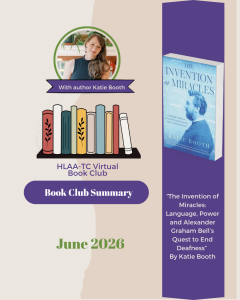
 On Tuesday, June 23, 2026, HLAA-TC Book Club met on Zoom to discuss the nonfiction book “The Invention of Miracles: language, power and Alexander Graham Bell’s quest to end Deafness” By Katie Booth. And author Katie Booth joined us for an engaging and insightful conversation on the man who has been mentioned many times in our previous readings. As we learned from the book and from our conversation with Katie, Alexander Graham Bell has an interesting and varied history with the deaf community (while his mother and wife were deaf and Bell spent a large part of his career teaching deaf students, he also was a large proponent of “Oralism” and felt that all deaf people shouldn’t sign but speak).
Talking points and links from book club:
- Author Katie Booth’s website
- This is her only published book under her name and she is currently working as a ghost writer (helping other authors write their books).
- Katie began working on researching the book soon after her grandmother’s death. Originally she had focused her research on the Clarke School (a known school in the US affiliated with Bell that taught (and still does) oralism.
- Katie’s website offers a great page explaining her background with the Deaf community and offers recommendations for further reading from deaf, DeafBlind and hard of hearing authors.
- The Clarke School is an active and prominent school educating deaf and hard of hearing students in the oralism tradition (no sign language). Their tagline is: “Clarke School teaches children who are deaf or hard of hearing to listen and talk.”
- The Clarke school website offers a history timeline of the school (showcasing Alexander Graham Bell).
- AG Bell Association: the current organization running under Alexander Graham Bell’s name.
- We learned about the technique created by Alexander Melville Bell (Graham Bell’s father, an elocutionist) and continued by Alexander Graham Bell called Visible Speech. It was a phonetic (made up of symbols) way of pronouncing things that intended to make it possible for deaf people to speak clearly.
- Visible Speech isn’t really used anymore but its techniques are similar to techniques used in speech language pathology today.
- Katie mentioned she was a Library of Congress Fellow for a year while she worked on the book. Someone she mentioned was also an LOC Fellow during this time and helped inspire her was Jeffrey Mansfield (an architect)
- A YouTube video on Visible Speech. It mentions a scene in My Fair Lady where Henry Higgins has a notebook showing symbols from Visible Speech.
- A movie from 1992 on Alexander Graham Bell and his father: “The Sound and The Silence”
- Books and things Katie recommended:
- “Articulate: A deaf memoir of voice” by Rachel Kolb (it is accessible in the BARD Library for the blind, etc. so I will add this to our list). Bookshop; Amazon; her website
- “Made to Hear: Cochlear Implants and Raising Deaf Children” By Laura Mauldin. (I had a hard time finding it easily accessible, so this may not be a selection for us.) University of MN Press; Amazon; A blog by the author about the book
- A Radiolab episode called “The Helen Keller Exorcism” featuring an author we read previously, Elsa Sjunneson (I previously mentioned and linked this in my February 2026 summary here)
- The memoir “The Country of the Blind: A memoir at the end of sight” by Andrew Leland (in the BARD library [DB115575] and already on our list) Bookshop; Amazon
Next book and book club: July 2026: Tuesday, July 28, 2026 5pm Western/7pm Central/ 8pm Eastern on Zoom: “When the Cranes Fly South” By Lisa Ridzén. (BARD: DB 132157). (ZOOM REGISTER HERE).